
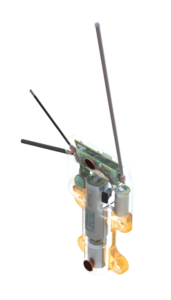
WEIGHT
109 g
LIFE
250 days
Lifespan estimates may increase or decrease based on your deployment. Please see your technical sales consultant.
Dimensions
109 x 58 x 21
About the SCOUT-TEMP
SCOUT‑TEMP is a marine telemetry tag designed to collect temperature–depth profiles and ocean structure from animals that do not perform clean vertical dives. Unlike traditional CTD tags that depend on idealized dive behavior, SCOUT‑TEMP reconstructs usable temperature profiles from real animal movement using segmented (broken‑stick) regression.
The tag generates temperature–depth profiles, mixed layer metrics, Time‑at‑Depth summaries, and Fastloc® GPS locations. These data products provide meaningful environmental context for species and study systems where traditional profiling approaches fail.
SCOUT‑TEMP is best suited for pelagic species such as sharks, making it a lower‑complexity alternative to CTD tags when salinity is not required. Full 1 Hz sensor data are permanently archived onboard and can be recovered if the tag is retrieved at the end of a deployment.
SCOUT‑TEMP expands the scope of animal‑borne oceanography by enabling temperature structure data from animals and behaviors previously considered unsuitable for profiling studies.
Features
- Broken-Stick Temp-Depth Profiling (PDT)
- Second-by-second Temperature Sampling While Wet
- Integrated Argos Transmitter with Fastloc GPS
- On-Board Archive Memory
- Configurable Transmission Schedules and Data Products
Benefits
- Collects temperature data where traditional sampling can’t—enables ocean temperature observations in remote, undersampled, or inaccessible regions by using animals as mobile sensors—extending coverage beyond ships, buoys, and gliders.
- Works with animals that don’t dive cleanly—produces usable temperature–depth profiles from horizontal, looping, or irregular movements, unlocking data from species that are poor candidates for traditional vertical CTD tags.
- Turns imperfect dives into valuable data—reconstructs meaningful temperature structure from fragmented or delayed ascents, increasing data return and scientific value from real‑world animal behavior.
- Improves interpretation of animal behavior and habitat use—adds thermal structure context to movement data, strengthening analyses of habitat selection, diel behavior, and energy use.
- Enables new science and funding opportunities—expands the types of oceanographic and climate‑relevant questions researchers can pursue, supporting interdisciplinary proposals and new funding pathways